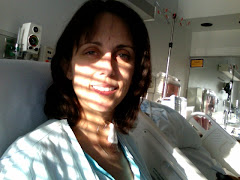
Of course I didn't sleep a lot the night before surgery. I have vague recollections of television and the hospital's movie channel. There were infomercials, too. I don't know if they gave me a sedative, maybe they did.
Marcie and Erich arrived before 4 on March 25. They apparently had to speak to security guards, as there aren't a lot of people around the hospital at that time of the morning. Apparently there's no way to get a parking stub, either... these were all small parts of the chit chat that morning. Erich is mellow. And sweet, and a typically weird 18 year old. (He's 19 now.) And sweet to give up a day of spring break to be with his mom.
The people (hospital assistants? OR staff? aliens?) arrived to transport me to surgery a little after 4:30. I was able to transfer myself to the guerney (sp?) to be rolled into the bowels of the hospital. I made sure that Marcie had all of my things (the five things that I had brought with me, and my wallet and phone...) and suggested that they go for coffee for awhile before going to the waiting room. Erich squeezed my hand, Marcie kissed my forehead.
I know I talked to my drivers on the way to the OR. I recall getting into the elevator. The UWMC is a sprawling facility which has been addended and remodeled about a billion times; I have no concept (even with my great sense of space and direction) of where, exactly, the operating rooms are. Somewhere Below.
Pre-Op is like a stable. Privacy curtains about 3/4 the length of each bed, and I think there may be 12 - 16 spots in the room for patients? (Hard to see from the horizontal.) That time of morning is shift change, so there was a low hum of passing conversation about how busy the last shift was, what's lined up for the day, who was going out for breakfast after work, what surgeons were on call, etc. I'm pretty sure families aren't allowed in there, but it seems to me that I saw the family come in with another patient. I was staring at the ceiling for the most part, though.
It was there that I got a second IV inserted. I met the anesthesiologist... briefly at first, enough time for us to establish our common German heritage (mine by name, his by thick thick thick accent), then he wandered off to order drugs. By the time he came back he re-introduced himself and his associate as my soon-to-be-best friends. I said in a mockery of complete and utter shock "what? I said no anesthesia! we are going to do this with a bottle of scotch and a rag to bite on!" Well. I thought it was funny at the time, and I think the dr. laughed. The nurses did.
I have been asked if I was scared. Or worried. Or excited. I have to say none of the above. It's hard to describe. The surreality of the surroundings impacted my ability to think beyond my breathing. The magnitude of what was about to happen hadn't really sunk in (I'm not so sure it has even yet). Having had abdominal surgery in the past, I knew fairly well what I was in for in terms of recovery pain. And beyond that, well, I believed the staff would do their jobs well. There wasn't any way to worry about prior decisions, or fret about the future. I just had to be.
The last think I remember is being wheeled toward the ER, with the warning that it might be cold and bright in the room. I was warm, so I think I said something about not being worried about that. There was music on. In the back corner on my left side there was a team of doctors seated on stools at a table working on the graft. And then I shut my eyes.
Somehow, I also remember in a lull of the activity that I did have the presence of mind to breathe deeply. When I'm on a heart/oxygen monitor I like to play with the screen and see if I can slow my heart rate and make the blips do different things. Breathing helps that. In the space of that breathing I also concentrated on making a welcoming place for my new liver. And being calm.
Showing posts with label Before. Show all posts
Showing posts with label Before. Show all posts
Thursday, May 7, 2009

Monday, May 4, 2009
Tacoma
I moved to Tacoma the August before I turned 17.
Relocation to college, officially moving out of the house (though my parents had really moved out before me), and becoming a Northwesterner was quite a production in my family. Kathy hadn't worked all summer, I had worked at Rax Roast Beef (finally being old enough to work legally) and our days had consisted of soaps, suntanning, and me working swing shift and bringing home the milkshake machine-cleaning to the dog...
Mom and Dad had lived in Yellowstone all summer, so moving entailed a van, a trailer, two cars, and three different routes. My stuff was packed into the cars and lord help me but I can't remember how all the other household stuff made it to Washington. (My parents sold the house when I started college.)
Priorities for me were 1. orientation and 2. finding a doctor. My doc in Utah referred me to Dr. W, who was to be my doc for the next 20 years. (20! And yet at my last visit I encountered another teary-eyed woman who had been to the office for 24.) With Dr. W came a lot of really really bad jokes, opportunities to teen-sit and house-sit, a woolly golden retriever (who was not leash trained... my favorite was the day Kathy and I had to chase him all over Point Defiance), a Sunset-worthy acoustically perfect house, and a Volvo station wagon (thus starting my love affair with boxy cars). I was spoiled.
My typical visit with Dr. W -- no kidding -- was 5 minutes of how I am doing and then 10 minutes about life, family, travel, and sometimes even politics (I think we disagree). So, given 20 years at four times a year for 15 minutes each, that's approximately 20 hours total. Throw in the odd procedure (and for GIs they are truly odd procedures) and I've spent the equivalent of 6 dinner parties with Dr. W. Add in the interaction surrounding house-sitting and social gathering, and we'll call it 10 dinner parties.
How can someone with so little contact have so much influence? I don't know. I do know that not every doctor is for every patient, and vice versa. There's a lot to be said for bedside manner (no matter whether one is in the bed or out of it), but sometimes personalities just mesh okay. I have had other friends who have seen Dr. W (the world is full of people with GERD and IBS and such) who do not care so much for him as I do. And, by extension (and subsequently of their own accord) his family.
I guess even intermittent contacts have had profound impacts on my life... my hair dresser, my dentist, my financial advisor, people I knew when...,
Tuesday, April 28, 2009
But he likes peanut M&Ms
Last night I got together with four work-related girlfriends... two current colleagues and two former -- for a walk along the waterfront. I got some dog love out of it and some great conversation.
I had been a little bit nervous, because one of my former colleagues' husband went into liver failure shortly after she had retired. His was an acute toxic failure, and by the time diagnosis was made and he was listed for a tx, he was simply too sick. He passed away within a year.
I thought the time would be awkward, but she is such a calm, open, and giving person, that it wasn't. And since the whole experience is still rather fresh for her, she was able to ask some really good questions.
As we talked (and of course there were about three million other interspersed conversations) I began to realize that she had had the "crash course" in transplantation, and how that was so beyond my frame of reference, and I had no sense of relation to her experience vis a vis timing. I mentioned this, and her response was a little taken aback, for she thought that a year was really a long time to be in the process.
It made me think last night. If I had only had a year, or less, to come to terms with the whole idea of a liver transplant, I don't know if I would have done it. And in hindsight I would doubt my ability to survive.
When I was first referred to see the hepatologists at the UW, I thought that it was for a, oh, I don't know, a second opinion, or news on research and new drugs, or an exam or a prognosis. The ramifications of going, of getting into the "system", just didn't occur to me. Dr. W recommended that my spouse go along... which was the first time he'd come to a medical appointment with me. I think that Dr. W thought that I would see his long-time friend and colleague, the senior member of the team. I think he thought that we would have a chance to talk to him before going to the UW.
Naturally, none of that happened. I took on all the stress for two of us, finding our way around the corridors of the UWMC (which has been in various phases of remodeling since the dawn of time), through blood tests, waiting for results, having a physical, meeting with nurses, interns, fellows, and then the fellow and the hepatologist, Dr. K.
I've gotten used to the brevity and absolute directness that many health professionals approach patients with, and on the whole I really respect and appreciate it. However, I think the first couple of words out of Dr. K's mouth were "well, looks like we'll call the social worker and have you interviewed for a transplant."
Oy. I did not react well. Transplant wasn't even in my solar system, let alone on my radar. I think my reaction (coupled with the cold sweat that ensued from the person sitting next to me) probably colored my opinion of Dr. K, but I developed a rather venomous dislike of the man within the next 2.4 nanoseconds. I found him to be supercilious, pompous, rude, and unkind (add to this that he is well within a decade of my age). My bristles went all-out and my nails were barely sheathed.
I feel sorry for the social worker who saw us next. I don't even remember who she was, because I had shut down during the half hour we waited (in the exam room) for her arrival. Stunned silence is never very comforting.
Over the next several days/weeks/months I faced all the following:
- I didn't feel deserving, that there should be someone who deserved a tx more than I.
- I didn't like the way health care is handled in the US and was embarrassed by the fact that I'd had so many more opportunities and had such better insurance than others.
- I was sure the docs were wrong and that genetic research would prove my salvation.
- The UW was more bureaucratic than even the federal government, and I found it inefficient and frustrating.
- I really wasn't "that sick". I'd always been "fine" and would continue to be so. I could handle it.
- The thought of waiting for someone to die was too macabre to dwell on.
I know there were more, but those were the first that lept to my mind. And most of them were not resolved until the last year or so, and a few are still in the file folder in my brain entitled "things I don't think too deeply about" (they share a space with pork, public restrooms, unfair labor practices in shoe manufacture, and the sex lives of relatives).
My opinion of Dr. K stayed that way for, well, I'll estimate about 5 years. It changed gradually (especially with the kind venting support Dr. W offered) stemming from the point at which I - while in one of the endless waiting periods between appointments - looked up from Foucault's Pendulum to see him shuffling down the hall blissfully snarfing a king-sized bag of peanut M&Ms.
Since then, Dr. W has retired, and Dr. K has left the UW. He is now my "regular" liver doc, and I like him a great deal. I would like to think that he has matured and mellowed being in a non-academic setting, but I think the better view would be that I've grown up. He still can't call me "kiddo" though!
August Day
After I was 15 or so, I stopped crying.
Well, I stopped crying for any reason other than extreme frustration and anger - usually brought on by exhaustion and stress, and usually aimed (oh I am so sorry) at colleagues, or at least near them. I had to have a shell in order to set some semblance of boundaries to my raging emotions. (Yeah, give steroids to a Scorpio sun/Cancer moon and watch how that works out for ya...) It was a way to cope, to live either in denial or stoicism or not wanting to bother others or... maybe just to avoid the rest of grieving (for what? lost opportunity? lost adolescence? the way I perceived my family had failed me? just being a teenager?).
I made it that way for about 16 years. I didn't cry again until 2002.
I had been remarkably 'healthy' through my 20s, had gone onto another immuno-suppressive drug and had been off steroids for nearly 10 years, and had thoroughly enjoyed grad school, getting out on my own, falling in love, getting married, and generally being the hedonist that lurks inside my soul. My GI (gastroenterologist, not military dude) even came close to 'firing' me a couple of times because there were few indications of progression of the disease or decompensation of my liver.
But about the time I turned 3o my bloodtests started to show the chronic indicators of liver disease: nothing but nothing could elevate my blood proteins, I was developing esophogeal varices, my blood pressure was too high, and my bilirubin counts were rising above normal. Dr. W broached the topic of referring me to the UW to meet with the tx clinic, and an appointment was made.
I made the unfortunate decision to invite my then-husband along to the UW for the visit, the first time he'd been involved in my health care in any way. It was an abysmally wretched (is that redundant? I will leave it because it was truly terribly awful) experience best saved for telling later.
The summer of 2002 sent me through the workup process for the tx waiting list, what seemed like endless tests and ever more prescriptions. I was not reacting well to any of it, and on top of that I felt pretty crappy all the time. Counseling helped a little, but complex knots don't unravel in the space of a few months.
August rolled around. I had been retaining water, and one morning I got ready for work and none of my clothes -- really, none, not even my fat pants or my elastic-waist skirts -- fit. I couldn't get my feet in my shoes and I felt miserable. Not only because of all the fluid retention, but anyone who knows me knows that I am a little (ha! understatement!) neurotic about clothes, how they feel on me, getting dressed for work in the morning, things not going as planned, getting up in the morning, worrying about freaky things happening with my body... so I wigged out and called in sick, and called Dr. W.
Turns out I had pitting edema. That's when you retain fluid to such an extent that when you, say, poke it, there's a dent left behind that takes up to a minute to un-dent. It's the kind of thing a 10 year old boy would think was totally awesome, right after belching and farts (sorry to be so stereotypical; a girl might think so too). For an adult, especially the aforementioned wiggy adult, it was very, very gross.
Dr. W only had to see me for about 8 minutes (typical of most clinicians, his appointments were 15 minutes long...) and was prescribing two more drugs for me, a balance of diuretics. At some point during the side-effects discussion he made eye contact with me. I swear I turned 13 again at that moment, my eyes welled up and my bottom lip popped out and started to tremble.
The man, bless his uber-chic urban heart, tapped into his fatherhood and husbandhood [an aside: I adore his wife and daughters, and to this day he is still the only person besides my dad who can call me 'kiddo' without getting sneered at] and said "get your butt in my office now."
He sat me down opposite his desk, and I crawled into my 13-cum-32 year old self. He looked me straight in the eyes and said for the first time ever the words no one had ever said to me before.
"Listen," he said. "This sucks. This sucks a lot because you never did anything to deserve this, and you haven't done anything to make it worse. And your best hope is to stay as strong as you already are and work at this and survive. I believe you can do that."
And the floodgates opened.
Now - and all the criticism and teasing be damned - I cry. Fully and unabashedly when I am happy, complimented, sad, tired, mad, touched. At work (and now I'm not so sorry), at home, watching EVERY movie I've seen, at Hallmark ads (cliche but so true), when friends are in pain, when dogs are in danger, on vacation (I am sorry about that, Martin!), and when I stub my toe. It's fabulous. I hope I never grow out of it.
Saturday, April 25, 2009
Commencement
I was just past 15 the next time I got really "sick."
I had been camping in Southern Utah with my parents and girlfriends over Easter break... I think that was the year we stayed at Dead Horse State Park and went traipsing around Arches and the "Fiery Furnace" hike. It snowed (my best friend Jill had a magic tent that conjured the snow) and we ran around and had fun. I still have some great photos. My friend Jen also barfed on the (naturally very cute) park ranger on that trip, too. Mom and dad stayed in the camper and made us wonderful hot food and lots of cocoa.
I had had blood tests the week before, and when I returned home (this was 1986, remember, no cell phones and my parents didn't even have an answering machine) there was an urgent call from the doctor. My platelet count was extreeeeeeeemely low. Like, if I had had a bruise or a cut I would have probably bled to death. That low.
The diagnosis (more blood tests! ultrasounds!) was acute thrombocytopenia... that is, that an abnormally high number of platelets were being removed from my blood by a terrifically enlarged spleen. This happens sometimes in people with autoimmune diseases like rheumatoid arthritis or lupus, too. I had been on relatively low maintenance levels of prednisone for a little over a year, but of course the main treatment option at the time was to pump me full of the 'roids again to see if my spleen could be beaten down.
This made me a very chipmunky person for Junior year play. This also resulted in a series of photos from my trip to Europe that summer that ... well, it's not all that easy to recognize me in them. (And thank goodness, because boy, I had TERRIBLE clothes!)
Unfortunately, the drugs did not bring the thrombocytopenia under control. About the time of my 16th birthday, it was recommended that I have surgery to remove my spleen. We were able to schedule it for Christmas break (oh yeah!) so I could miss as few of my senior year classes as possible. That was my first experience with general anesthesia, multi-day hospital stays, and the irritation of a naso-gastric tube. Also I learned that nurses and "rounders" appreciate candy and suction-cup dart guns, and that morphine is a lovely lovely thing and can elevate bad Disney movies (Journey of Natty Gann) to high art. (Hee hee hee, "high" art...)
An ironic thing now is that since tx I have had to take a daily aspirin to keep my platelets under control. They have never been high since the splenectomy, but now that I have a liver that's actually doing its job, I have platelets galore. Aspirin makes them less sticky, and less likely to clot.
Tuesday, April 21, 2009
The Call
There are a series of odd, pithy emails somewhere on here from the morning of March 24. I was a little late getting into work... okay, I was a lot late. I had been out the evening before checking out the site for Revels' fundraising breakfast, hadn't eaten dinner till 9 or so, and... well, just needed a little extra time in the morning.
I think I was aiming for a 9:30 arrival (I would make it up later in the day) so was blowdrying my hair when the phone rang... I shut the dryer off just soon enough to hear the "new message" notification on the cell. Unknown number. The message said "Hi, Shirley, this is ____ from the UW Transplant program, and we have a liver for you. I will leave a message at your work phone, too, but it's very important that you call me back within the hour."
It occured to me this morning that the message is still on my work phone.
I breathed. It's pretty common occurance that tx patients will receive more than one call during their wait-list time. They'll be admitted to the hospital, and some test or other -- either for the patient or for the donor -- will make surgery a no-go. For instance, if the patient has either a hint of an infection or virus, if chest x-rays aren't clear, if there's any open wound... they will be sent home. So half of me thought "this could be a dry run... no guarantees."
So I called the UW back. She said "are you ready?" And I said "yes. This will stink for the people at work, but yes, I am ready." I was to check in to the hospital by 11:30 for tests and work-up. I thought about driving myself. Fortunately Marcie talked me out of that, and headed out immediately to drive me to Seattle. I packed a bag, thinking I would be home later Tuesday or Wednesday at the latest (i.e., I packed jeans and a t-shirt and thankfully my toothbrush), tried to send some emails, and let work know that I'd either be in Wednesday or not for quite awhile. Love that predictability!!!
One of my Facebook posts was that I had thought my biggest decision of the day would be whether or not I could get away with wearing jeans to work. In a sense, that was still the biggest decision of the day... because there really wasn't a decision involved in going up to the UW. A friend asked me about it later, and I realized that this decision, as with most truly important decisions, wasn't made in a day. Rather it was made in fits and starts over the space of 7 years of doctor visits, intimate conversations, fights with myself (and with others), pointed and poignant questions from people close to me, and insightful questions from complete strangers.
Throughout the day on Tuesday I pretty much sat. Had a lot of blood drawn, had an IV inserted, had x-rays, talked to a lot of staff. I met the surgeon on call, whom I had never met before, and he did a brief physical (wanted to check out incision possibilities), and of course I couldn't eat, since it wasn't entirely clear when I would be going to surgery. I knew that there were two donors that day -- I had a 'neighbor' during workup who I still see in Clinic, who went into surgery Tuesday evening. I was scheduled, then, for Wednesday morning.
(There's an explanation for the scheduling and the delay, but that's another topic entirely.)
My surgeon was called in about 8 in the evening. He introduced himself as "the substitute" which made me smile; I was also happy because I have met him twice before, and there's something nice about recognizing a face.
One of the other things about the tx process is that -- frequently -- the surgeon/tx team will give the patient some details about the donor, and the graft (the term for the organ to be transplanted) and whether there are any risks involved. Some staff give patients more information than others. I asked the surgeon about it at this time, with something like "I understand that generally there's a discussion of the donor, the condition of the graft, and whether or not it's something I want to choose to agree to."
I got a solid look. "There are no concerns. The donor was significantly younger than you, and healthy. If there was anything to discuss, we would." In essence, I heard "this is the best you will ever get in all possible situations so there is no discussion." Then he said "try to get some rest, and keep your spirits up. I will see you around 5 in the morning."
Rest, hunh.
Sunday, April 19, 2009
High School
I changed a lot over the summer between my first and second years of high school. If my scanner worked I could scan in the photos. They are pretty telling.
More than any other young teen, I became really self-absorbed. I was so focused on not being miserable and maintaining some sense of normality in my life that I was really quite abnormal. I had a few close friends, and I just assumed that everyone else hated me! Now, I probably would have felt that way anyway, being a monster nerd. I have since learned to wear that label proudly (I also claim "geek" and "dork" quite readily, with a self-deprecating snicker), but in high school it's far from a badge of honor.
I never took the time to think that the other kids had their own worries and troubles... it seems like a lot of the four years just occurred around me, and I muddled through, a somewhat arrogant twit without much thought for others. But then, maybe few people noticed.
Sure, some kids were mean. I was the 'star' of more than one rather cruel cartoon, and there were some pretty nasty pranks playing off my rather sad over-attachment to my dog (I know that's totally surprising given how pet-focused I am to this day) and the yo-yo weight thing... 30-ish pounds on and off at least twice during the four years. I always blamed it on being 'sick' and it took a long time to gain the perspective that, hey, high school generally sucks in some major or minor way for about 99% of kids, and maybe my high school would have been no different if I'd been the portrait of health. (But I sure would have drunk more!)
One of the miracles of the internets, though, has been the opportunity to re-connect -- even tangentially -- with people who made it through St Joes in my cohort. They are all the most amazing adults - with varied and totally impressive careers, good lives, and a certain generosity of spirit, curiousity about other people, and a sense of comeraderie which I really didn't expect.
Maybe this proves that I'm still pretty self-focused, and I need to grow out of that more. I've changed a TON in (oh dear) 22 years (ohhhhhhhhhhhh) so why wouldn't everyone else?
In many ways, though, I still let my family get away with treating me like I am 15...
Saturday, April 18, 2009
May Day
By the time the liver biopsy results came back, I had already had blood tests galore. I had tested negative for all the hepatitis viruses, any sort of rheumatic problem, Wilson's disease. I didn't have the necessary symptoms to indicate lupus, and obviously the fact that my liver was up to 50% scar tissue could not have been due to alcohol abuse or drug use, and it was unlikely that I'd had toxic exposure to any chemical.
If I recall correctly, the test for antibodies that attack one's self was pretty new at the time -- they had just figured out T-cells and it was pretty conclusive that I carried an anti-smooth-muscle antibody. This meant, essentially, that my body's immune system was attacking itself. In people with rheumatoid arthritis, this attack was aimed at the tissue of the joints. In me, the attack was aimed directly at my liver.
The response, then, was to suppress my immune system, to beat it into submission to such an extent that it would cease to attack me. That also meant I would be susceptible to other illnesses, but vigilance with exposure should protect me.
The drug of choice was prednisone -- not the anabolic beefcake kind -- but prednisalone or methyl prednisone, used to suppress immune system as well as reduce inflammation. And, oh yes yes yes!!!, predinsone is so totally the teenager's dream drug. The primary side effects:
acne
weight gain
hirsuitism
and...
extreme and sudden mood swings
How could I not just be overjoyed!!! Let's ignore the fact that puberty and high school are already rough enough, add on those things. Plus some rather fantastic psychedelic dreams, the eventual onset of osteopoenia, and wow. And in the space of 4 months, I went from catepillar (rather scruchy but endearing little creatures) to pupa (puffy and ugly and impossible to see what's inside). I wasn't fortunate enough to get Gary-Coleman-cute chipmunk cheeks, and unlike my friend Rose (with some sort of rheumatic problem) was unable (or undisciplined enough) to avoid significant weight gain.
To add insult, my school instituted uniforms the fall of my sophomore year. And I had perpetually bad hair. You get the picture. On the upside, I have to say that I never really suffered from PMS because I felt that way all the time.
And yet in high school I had friends. Like, four that I knew of...
Wednesday, April 15, 2009
Thirteen
I still remember a lot about the day I first received the diagnosis of chronic idiopathic autoimmune hepatitis. I was thirteen. It was spring. I was a freshman in Catholic high school.
Here's a poem I wrote about it when I was a freshman in college:
May Day
Ironic, that the first tears shed
were when they said she wouldn't die.
It wasn't there in the dim levelor-
striped light of the office; while there
she held it together and smiled.
To this day Mother quotes her on some
wise-beyond-thirteen remark
she never did say, about eighty percent being good
odds and nasty side effects not mattering.
Then she said "Don't worry, doctor
our little one's not vain. She's
handling this all quite well."
Outside May skies wept and at home
she sat alone in the dark
bathroom, stared at the vague person
above the sink, thought of who she used
to be and what she was about
to become, remembered the boys and the parties,
popularity and beauty and now only
that she must make others proud
and then began to hate herself
Inside she wept and today
she thanks God that no one was
there when she sat on the windy bluff thinking
eternal thoughts
and wished that on the way
home some drunk would cross the center and
set her free.
I hadn't really been sick. There was one day in December when I had been yellow, but I also had a yellow bathrobe. I slept a lot (2-3 hours after school and then another 8 hours over night, and all weekend), but I was 13. School was hard and I was working hard, and sometime in January I had gotten the flu and then a bronchial problem that wouldn't go away. I had antibiotics and during a physical my pediatrician noted that my URQ (upper right quadrant) was tight - thus that my liver was inflamed.
For some reason, before they could do a liver biopsy, there was a 3-month time of blood tests (mine were bad) and inflamation that needed to be documented... so I think I had my first overnight hospital experience sometime in April. That would be 25 years ago this week or last.
They kept me overnight since I was young. At this time I was seeing my first GI (gastroenterologist) who did the procedure. They are still done the same way - a pretty thick needle with a notch cut out of it is inserted between the ribs and into the liver, then a sleeve comes down over the needle and a notch of tissue is removed. I think they attempt to sample only one or two pieces... but with my first biopsy they needed 4 to get enough tissue and not scarring in order to do the pathology. I was thankfully sedated very heavily. (My long infatuation with sedation began so early!!!)
Then, about two weeks later, the diagnosis...
Subscribe to:
Posts (Atom)